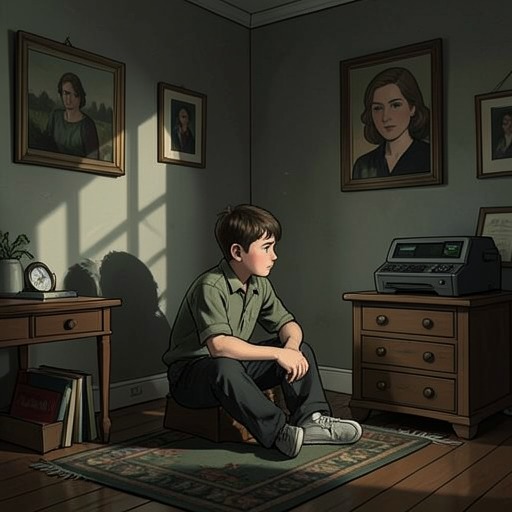
Jamie Rebuilds Family Relationships with His Parents and Adi
Call Me YoursJamie Rebuilds Family Relationships with His Parents and Adi is the reconciliation sequence in which Jamie, after years of absence, dissociation, and blocked memory, is restored to the family relationships that his fractured life had obscured. The event joins two recognitions: Jamie’s parents acknowledge and embrace the adult son they once failed to make feel loved, while Jamie learns that Adi is his sixteen-year-old daughter and immediately claims her as part of his life. Its decisive movement is from concealment and abandonment toward physical reunion, spoken love, and the possibility of an honest family identity.
Background and Hidden Family Structure
The reconciliation becomes possible only after the concealed history of Jamie’s household has been exposed. Jessica explains that she discovered Jamie’s alter ego, Kayla Renae Morrison, while following him and learning that Kayla was wealthy, owned hotel chains, and possessed a mansion. At the time Jessica was pregnant with Adi, she waited for Jamie to return, but he rarely did until Adi was twelve. When Jamie’s identity resurfaced, his mind had blocked out their daughter, while Kayla accepted Adi as her own and did not remember that Jessica had brought the child into her home. Adi therefore grew up inside a structure of contradictory maternal and paternal identities: she called Kayla “mom,” knew Jessica was her biological mother, and was instructed to remain hidden whenever Jamie came around so that his amnesia would not expose or injure him.
That secrecy generated a chain of injuries rather than protecting the family. Adi resented Jessica for failing to defend her when Kayla was harsh, for withholding ordinary maternal affection, and for maintaining what she experienced as a cruel charade. Jessica’s fear of discovery turned care into concealment, while the family’s silence allowed each person to interpret absence as rejection. Earlier confrontations show how unstable this arrangement had become: Adi demanded that Jessica tell Kayla what she had told her, and warned that the secrets within the household would eventually bring everything down. The reconciliation consequently addresses not one isolated misunderstanding but an entire family system organized around hidden identities, blocked memory, and deferred truth.
Jamie’s Reunion with His Parents
Jessica first prepares Jamie to meet his parents by assuring him that he is normal and suggesting that they are waiting outside the door, anxious that he may never forgive them for failing to make him feel loved. Jamie is frightened and unsure what he could say, but Jessica tells him that he does not have to say anything. The scene deliberately makes bodily presence precede explanation: she ushers in his parents, whose worry is visible in their faces, and his mother immediately crosses the room to embrace him.
The parents’ arrival changes the meaning of Jamie’s long disappearance. His mother tells him that she loves him, calls him her son, and admits that she had never said it before. She says that when he left, a part of her felt missing, and that she and his father searched for him for years. His father likewise says that he loves him and apologizes for not being a better parent. These admissions do not erase the earlier failure, but they name it directly instead of allowing it to remain an unnamed cause of Jamie’s suffering.
Jamie cannot answer with a carefully prepared account of the past. His tears, the loosening of the knot in his stomach, and his embrace of both parents carry the scene toward release. When he says that he loves them, the narration identifies the voice as belonging not simply to the adult Jamie but to the broken little boy inside him. The reunion therefore repairs two temporal levels of the self at once: the present adult receives his parents’ love, while the wounded child finally expresses the attachment that had remained trapped beneath abandonment and dissociation. Words matter, but the embrace comes first, making reconciliation an embodied act of recognition.
Discovery of Adi and the Father-Daughter Bond
After his parents leave, Jamie remains with Jessica, whose touch and jasmine scent provide a sensory continuity he can still remember despite fugue amnesia and dissociative identity disorder. Jessica then takes a photograph from her purse and tells him that there is someone he needs to meet. The photograph shows a round-cheeked baby in a bassinet. Jamie instinctively recognizes the child before his conscious mind can accept why, and the image forces him to confront a pregnancy and birth that his memory has erased.
Jessica identifies the child as Adi and tells him that she is sixteen. Jamie breaks down, but the tears are joyful rather than despairing. His repeated declaration that he has a daughter converts the photograph from an object of evidence into the first material bridge between him and a relationship stolen from his conscious history. He kisses the picture, asks what Adi looks like, and listens as Jessica describes her as stubborn, feisty, resilient, and strong—qualities that also connect her to him.
Jamie’s response is immediate and active. He does not retreat from the revelation or treat Adi as merely another fact about the life he cannot remember; he cries that he wants to meet his daughter. The desire to meet her is the event’s forward-looking promise. His recovered family identity is not limited to being someone’s son. It expands into fatherhood, giving him a new relationship to pursue and a responsibility that cannot be fulfilled through memory alone.
Adi and Jessica’s Reconciliation
The parallel reconciliation between Adi and Jessica occurs after Chris Davis is gone and Adi has lost the refuge she found in his small apartment. Adi’s grief is intensified by the history of secrecy: she had hated Jessica for not stopping Kayla’s harsh treatment, for not ending the charade, and for withholding the affection expected from a mother. Her isolation shows the cost of protecting Jamie’s fragile identity without adequately protecting Adi’s emotional life.
Jessica approaches Adi’s closed door and pleads for a conversation. Adi initially remains behind it, her throat burning and tears stinging her eyes, but eventually opens the door and rushes into Jessica’s arms. The movement through the doorway reverses the family’s established pattern of concealment. Adi is no longer being ordered to stay hidden; she chooses to admit Jessica into the room and into an emotionally direct encounter.
Jessica apologizes and explains that she had been so focused on getting help for Jamie that she failed to recognize the toll the situation was taking on Adi. She then tells Adi that she loves her. Adi’s question about whether she may call Jessica “Mom” gives the reconciliation its clearest test: biological truth must become an acknowledged relationship rather than remain a secret known only to the adults. The question does not undo years of hurt, but it opens the possibility that Jessica can finally occupy the maternal role she had concealed and neglected.
Consequences and Narrative Significance
The event restores family connections across several broken lines at once. Jamie is received by his parents, learns of Adi, and chooses to meet her; Adi moves toward Jessica after years of resentment; and the family’s hidden history becomes something that can be spoken, witnessed, and renegotiated. The sequence also reinterprets earlier objects and disclosures. Photographs, letters, household secrets, and the concealed history of Kayla Renae Morrison no longer function only as evidence of deception; they become materials through which the characters reconstruct a life that memory and secrecy had fragmented.
The reconciliation is therefore not a simple return to an earlier normality. Jamie’s parents must acknowledge their failures, Jessica must admit that protecting Jamie helped abandon Adi, and Jamie must build a relationship with a daughter he cannot remember raising. The family is repaired through confession, apology, touch, and a willingness to accept that love can survive discontinuity without pretending that the damage never occurred. In the larger arc, the event provides an emotional counterweight to the violence of kidnapping, coercion, theft, and identity control: where those forces divided people by replacing truth with imposed narratives, reconciliation begins when each relationship is allowed to speak its own name.